

LOS PASEOS: 18 DÍAS Y 376,5 KM
“Todo animal salvaje (…) es más sensible al movimiento que a la presencia formal o material”
J. Durand

Sobre el conocimiento a través del movimiento y el uso del cuerpo como herramienta para el dibujo.
En octubre, Alban me invitó a realizar una residencia artística de 18 días en Saint Palais, Francia, con motivo del festival Points de Vue que se realiza cada año en Bayonne.
Hacía tiempo que me rondaba la idea de poder realizar un proyecto con doble intención, donde la obra final cediese el protagonismo al proceso, a los cambios sucedidos durante los días de creación y era una buena oportunidad.
Saint Palais (Donapaleu) es un pequeño pueblo situado en el País Vasco francés, parada obligatoria de peregrinos en el Camino de Santiago antes de cruzar los Pirineos.
Cada vez que viajo para pintar trato de aprovechar el tiempo al máximo y conocer los lugares mediante paseos en ratos libres, saliendo a correr por la mañana antes de empezar o utilizando una bici como medio de transporte. En estos tiempos tan frenéticos resulta muy complicado darse cuenta de dónde está uno realmente, qué hay a su alrededor, cómo es el suelo que pisa a diario o a cuántos metros de distancia del hotel se encuentra el muro sobre el que voy a trabajar.
Esta vez decidí utilizar mi obra como excusa, mi trabajo como puente entre mi entorno y mi cuerpo y el movimiento como punto de partida.
No es fácil llegar a un lugar como Saint Palais, nada familiarizado con las intervenciones en la calle y ponerte a pintar sin más. El proceso debía ser distinto, íntimo y responsable, como cuando te acercas poco a poco y con precaución a algo que desconoces.
Mi primera intención y como sucedió durante los primeros días era recorrer el pueblo, entenderlo e interiorizarlo, y a la vez, dejarme ver paseando una y otra vez por las calles mientras buscaba posibles localizaciones, grabando mis paseos y tomando registros de los lugares que resultasen interesantes. Sin darme cuenta, iba creando un camino que repetiría una y otra vez durante los 18 días que estuviera allí.
Aprovechaba las mañanas para salir a correr o montar en bici y así visitar otros lugares algo más alejados, extendiendo mi dibujo corporal sobre el mapa y generando en mí una visión más global y acertada de la zona, tratando de sentirme lo más cómodo posible.


Días de búsqueda de las posibles localizaciones en las calles de Saint Palais:


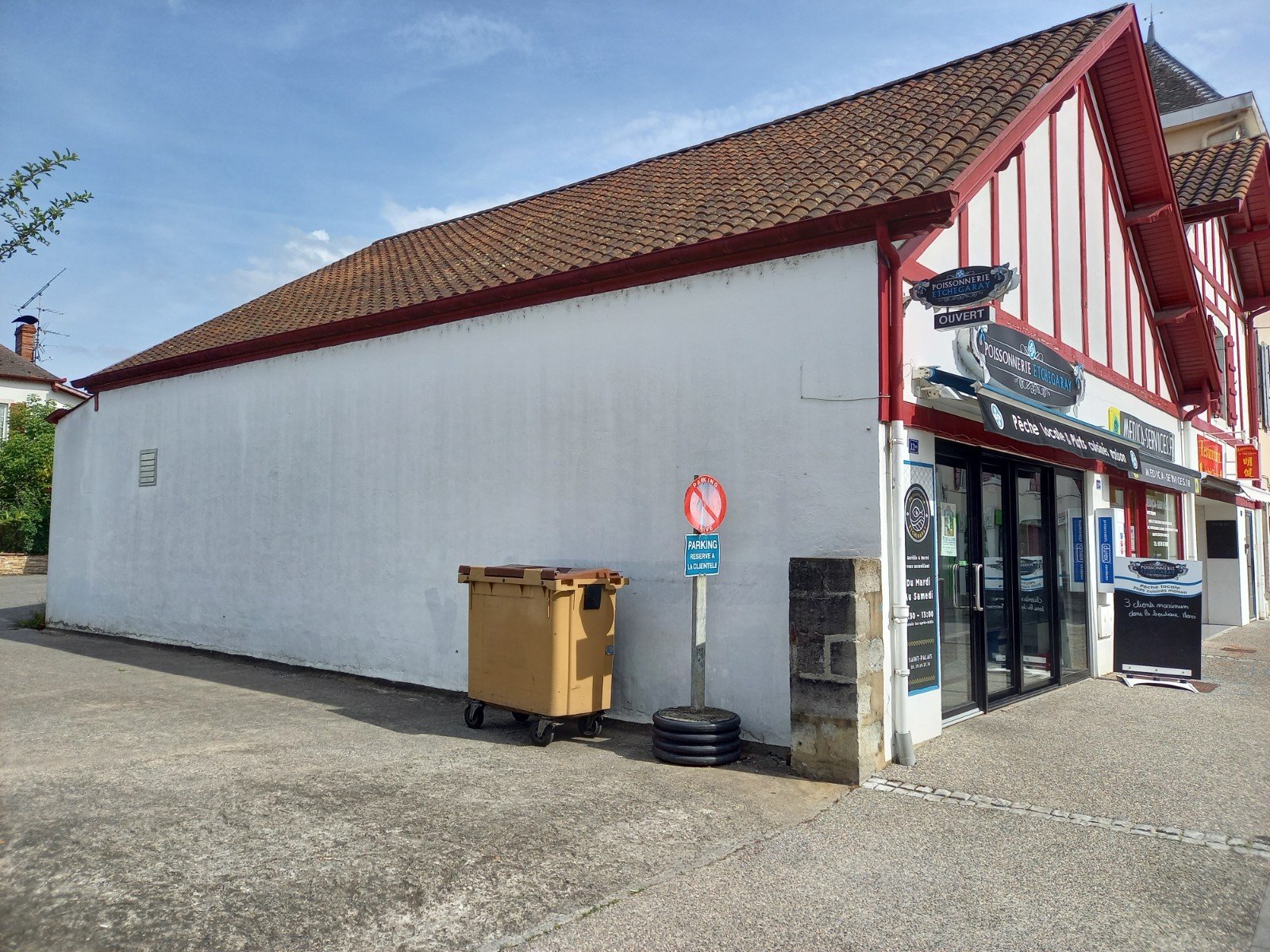


El 25 de septiembre comencé a pasear, correr o pedalear, dejando todos mis pasos registrados y ordenados.
La repetición de un mismo recorrido comenzaba a resultar rutinario y me permitía buscar detalles que en las primeras caminatas pasaban desapercibidos. La sorpresa inicial se transformaba en confianza y reconocimiento del espacio, y es ahí donde aparecen los detalles.
Mis pasos dibujaban recorridos sobre un mapa que un GPS se encargaba de grabar, permitiéndome crear un “rastro” o huella digital que genera un dibujo aleatorio e improvisado sobre el espacio.
La acción de pasear era como coger un lápiz y, de forma inconsciente, arrastrarlo sobre el papel una y otra vez, trazando líneas que muchas veces y por azar, acababan coincidiendo y dando paso a los primeros dibujos:

Día 1 - 11,3 km, localizando.

Día 1 - 14,9 km, carrera.

Día 2 - 6,33 km, localizando.

Día 2 - 16,04 km, carrera.
· · ·
Después de 4 días las localizaciones para las obras estaban definidas. Habíamos seleccionado 7 paredes para intervenir y recorridos algo más de 80 kilómetros. El dibujo sobre el mapa iba creciendo, junto con el conocimiento del espacio, las calles, plazas, iglesias, árboles, restaurantes o esas pastelerías francesas tan famosas ya eran familiares. Conocía dónde conseguir las mejores verduras, a qué hora y sobre qué fachadas golpeaba el sol (cuando no llovía), dónde tomar un buen café y por qué calles cruzaban el pueblo los peregrinos antes de llegar a los Pirineos. El rugby se jugaba los sábados a las afueras, los colegios estaban cerca del hospital, los habitantes ya empezaban a saludarme y el domingo TODO cerraba. En definitiva, el movimiento me había permitido descubrir y descubrirme.

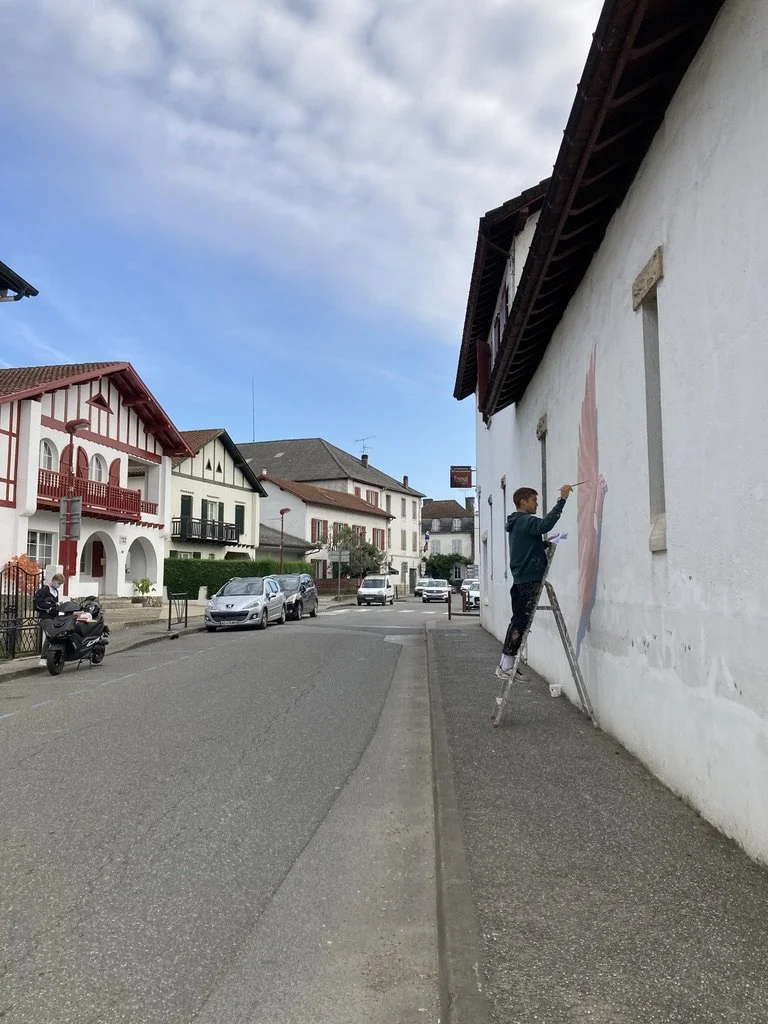
El día 5 empecé a pintar.
La obra consistiría en la realización simultánea de 7 murales repartidos a lo largo de las 7 localizaciones seleccionadas previamente (ver en mapa más abajo), los cuales una vez terminados compondrían una única pieza.
Cada uno de ellos corresponde a un “frame” de la secuencia de vuelo de una paloma salvaje o torcaz, animal muy representativo en esta zona del País Vasco Francés, que realiza grandes viajes migratorios cada año hasta llegar aquí.
Los pintaría de forma simultánea o en cadena, realizando el mismo paso en cada uno de los 7 murales a la vez, continuando así con mis paseos diarios.
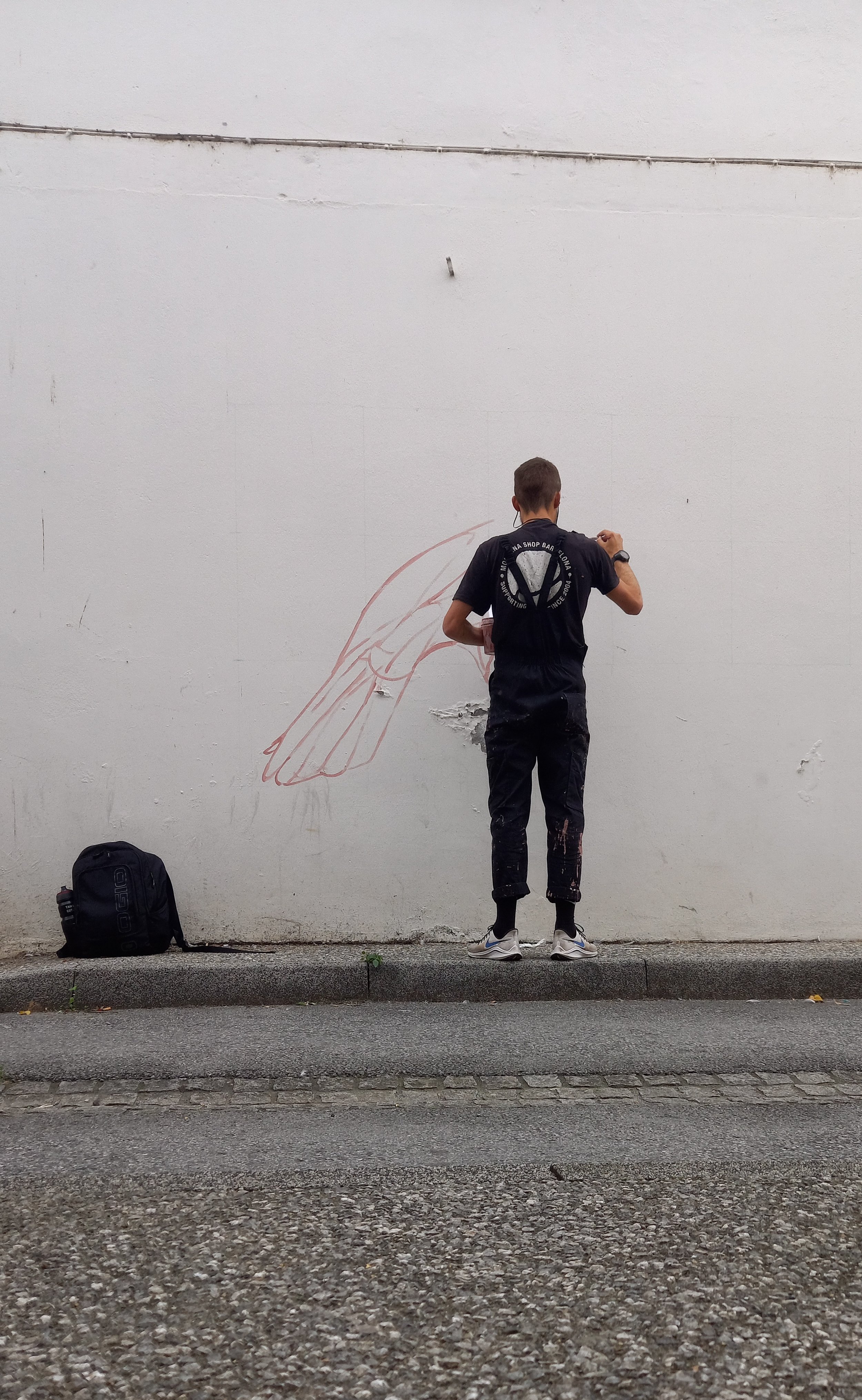
Todos los días comenzaba a pintar donde lo había dejado la tarde anterior. Empecé encajando el dibujo de todas las palomas; cuando acababa una, paseaba hasta la siguiente localización y así sucesivamente hasta terminar de encajar el boceto de las 7 palomas. Después realizaba el mismo proceso con cada color que pintaba. Lo usaba en todas las localizaciones hasta poder pasar al siguiente, hasta un total de 18 colores con sus correspondientes paseos. La última fase corresponde al trazado de las lineas y registro fotográfico de todas las piezas, una a una, para crear la obra final: una animación de la secuencia de vuelo que unifica todas las obras.
Los kilómetros, pasos, jornadas, inclemencias y anécdotas se iban sucediendo durante todo el proceso y continuaba registrándolos generando un mapa diario de calor que se sumaría al de días anteriores, creando una especie de diario del movimiento. Todos los paseos los hacía cargando con una escalera, agua, los bocetos, un pequeño cubo de pintura y un par de pinceles.
Tras 5 días de aclimatación y localización y 13 días pintando y paseando, el proyecto había llegado a su fin.
· 18 días
· 7 murales
· 376,5 km recorridos
- 192,3 km corriendo
- 116,9 km paseando
- 68,3 km en bicicleta
Registros y documentación:
Los procesos:
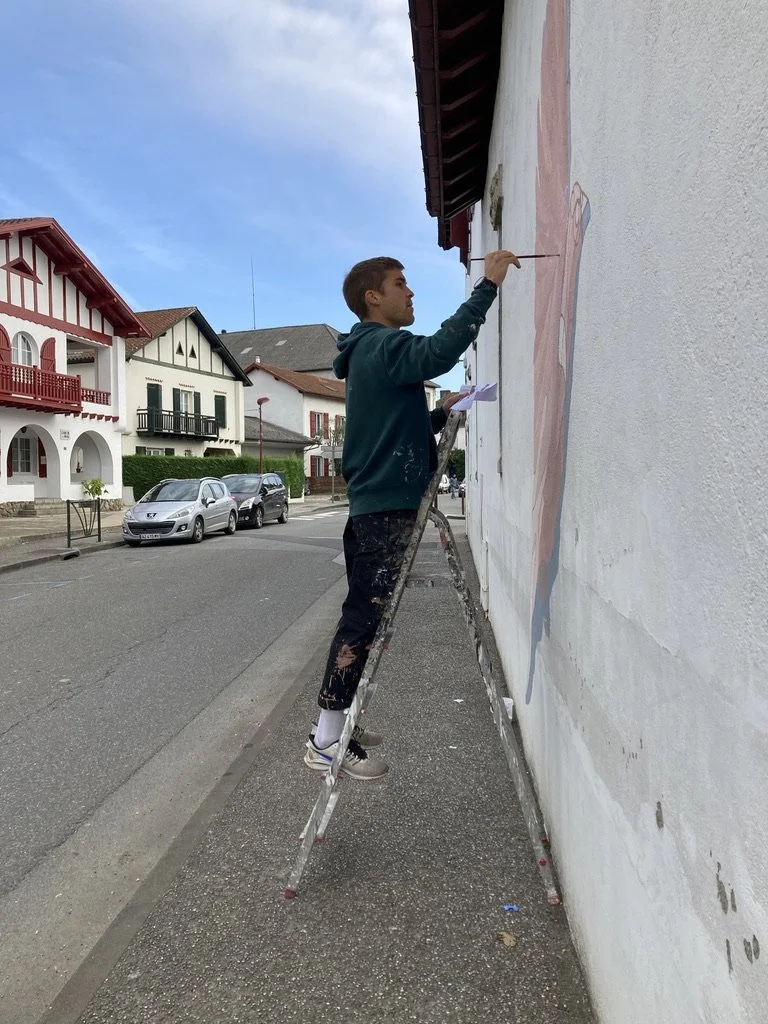

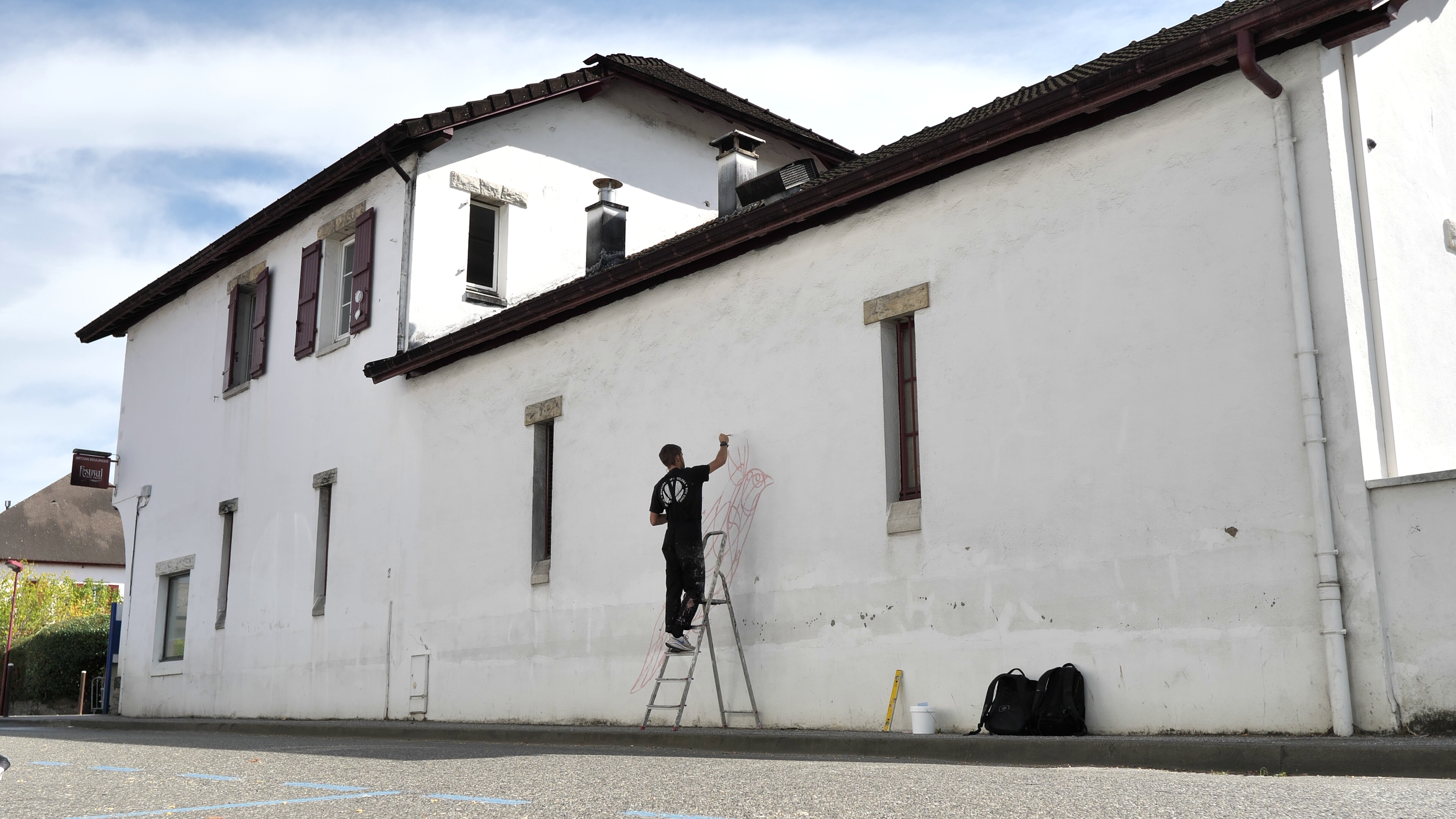


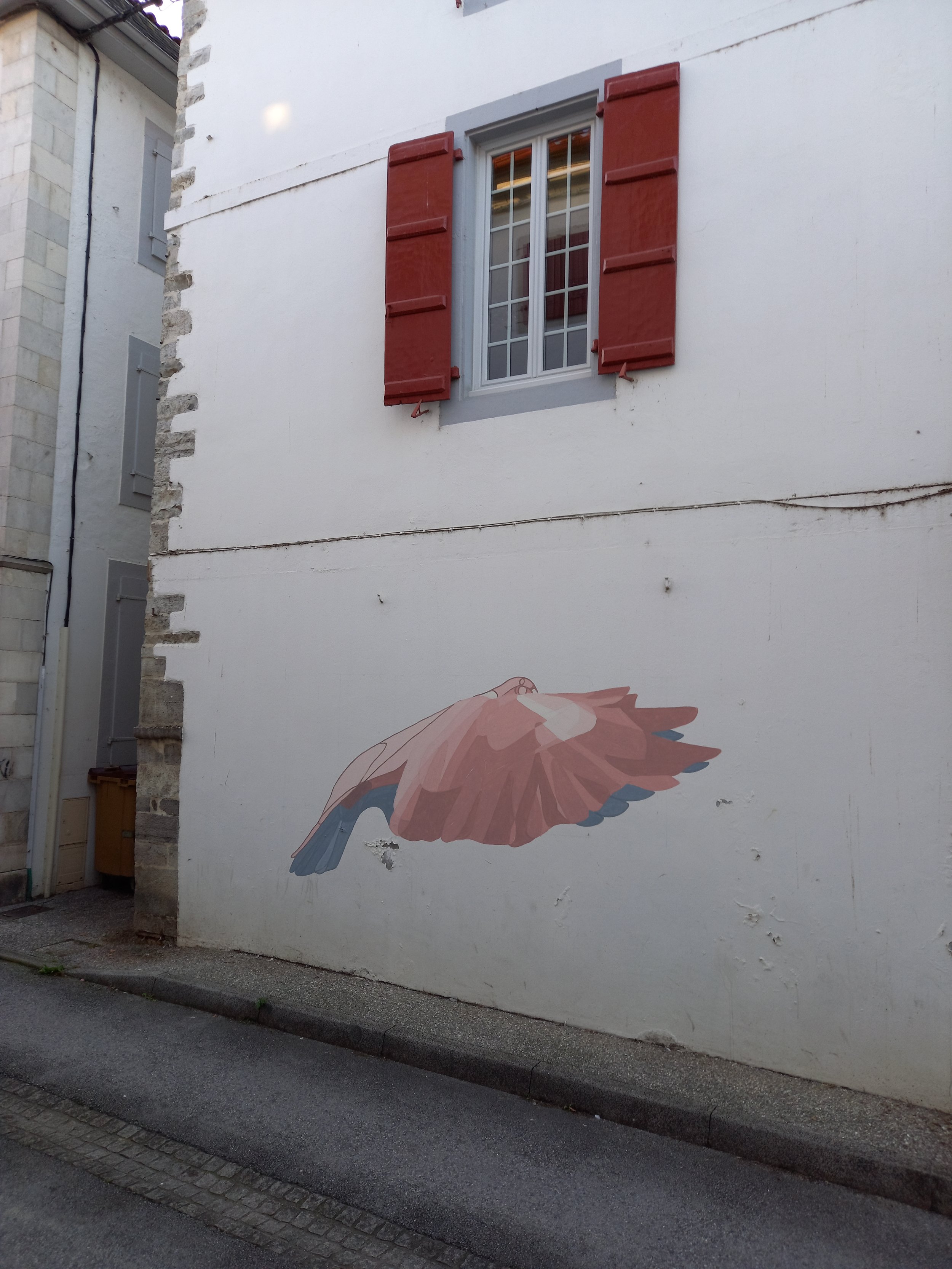
Los paseos: dibujos generados mediante caminatas diarias entre los murales.


Otros movimientos: dibujos generados mediante carreras y desplazamientos aleatorios.


Mapa de movimiento total en Saint Palais:
18 días y 376,5 km.


Secuencia completa del vuelo de una paloma torcaz:


Video resumen del proyecto:
Muchas gracias a Alban Morlot (PDV Festival) por la oportunidad y la confianza en mi trabajo, a todo el pueblo de Saint Palais por el trato y en especial a Ludo e Isabel por acogerme.
Al ayuntamiento de Saint Palais, a Kultura Pays Basque, a Spacejunk y el resto de organizaciones que lo han hecho posible.
También al colegio de Amikuze, profesoras y alumnos por su implicación durante los talleres y al restaurante La Gambeta.
Ha sido un placer por mi parte realizar esta residencia de la que me llevo algo más que un puñado de kilómetros y mucho aprendizaje.
Hasta pronto!
Fotografías: Julien Dizdar, Isabel y Taquen
Vídeo y entrevista: Julien Dizdar

VENCEJOS, VUELOS Y FRONTERAS.
Swifts, flights and borders
I have been fortunate to return to the Alps to paint again. This time to participate in the Eternelles Crapules Festival, in Briançon. A small French town hidden between valleys and mountains with incredible landscapes. And I must say that the road there was not entirely easy, but finally everything turned out well. It is a paradox but I would like to tell you about it:
It had never happened to me before, but when you participate in these types of festivals, creative "freedom" is usually one of the pillars, but it couldn't be completely like that. I had to go back in my steps and, after many changes, give my arm to twist to present a new sketch, which did not talk about borders, immigration or refugees. I must emphasize that it was not a matter of the organization. Sometimes it is difficult to talk about what yourself would like, and migrations are among these sensitive topics.
Making the decision to accept it and move on was not easy. I looked for a way to continue talking about what I would, without speaking directly about it, and I found a good ally in the royal swifts. I really wanted to go to Briançon to participate in the festival, but it was clear to me that I couldn't not talk about what happened, and that the opinion of some should not influence my participation.
After all, how could I not participate in a project like this in a place like Briançon.

By Fabe Collage
After 17 hours of travel and 4 different vehicles, a vaccination passport and several stopovers, I arrived in Briançon to carry out this mural and to participate in the festival together with the rest of the artists.

By Fabe Collage

My new proposal has had the Royal Swift (Apus apus) as protagonist. A bird that does not need to touch land to cross borders. Every year they travel twice throughout Europe and Africa. They can and do travel thousands of kilometers without perching, without giving explanations and without needing them. They are animals that can spend several months flying in the air, without having to stop, to their final destinations in search of better climates.
They cross the Mediterranean Sea in large groups, fly over the Pyrenees or the Alps and reach the Carpathians, then they return to warmer areas after a few months.


It has been a pleasure to be part of this festival and have enjoyed this place, see you soon without a doubt.
Thanks to Lucas and Maelle for all the effort and to all the artists I have met there.
Ah, the return at least was more enjoyable…
Pictures by Fabe Collage.

SER ÁRBOL PARA LOS ÁRBOLES. MOSTAR, BOSNIA
“To be a tree for the trees. Be oak.”
This is the title of my last mural that I made for the Street Art Festival in Mostar, Bosnia. A special city, with a very special atmosphere.
In early September I have spent 10 days in Mostar, painting, walking and enjoying a lively and joyful city that very recently experienced a civil war that can be seen on every wall, on every corner. All the buildings are "adorned" with many bullet holes, as a souvenir, with which the inhabitants of Mostar coexist so as not to forget.


Being able to cross the city on foot every day was a gift. Going to the wall, going to eat, coming home, visiting the other artists ... there was always a new corner to walk through.
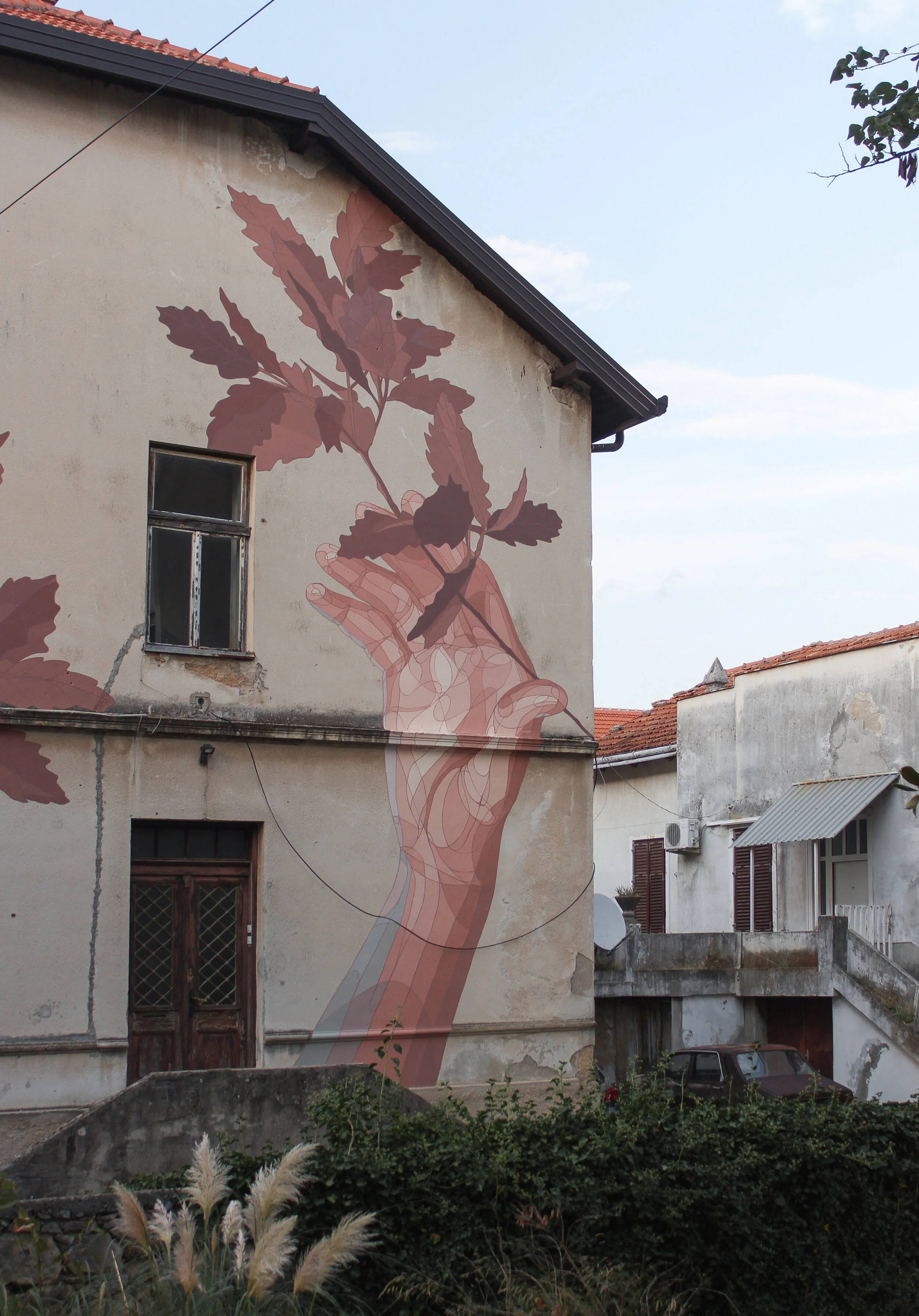
The location of my mural could not be different. An old house where today only one family lived on the lower floor. Surrounded completely by nature but located near the city center, a perfect and delicate environment, with much to tell on its own. This is why I decided to give great importance to the background and try to respect it as much as I could, trying to mix my work with the whole environment.
This was the final result:

To hold or support the oak, to be a tree for the trees.
In Latin “robur” means strength, but also oak.
Food and home for more species than any other.
Symbol of generosity and patience.
Hundreds of years to grow and up to fifty to flourish.
To be oak for the trees,
be oak.
Some details and photos about the process:



Thanks to the entire organization for the treatment, to the rest of the artists I met: Ricardo, Pelucas, and Medianeras ... for the good times, and to the people of Mostar for treating me so well.
Special thanks to Marina for all the work and making it possible.
It has been a pleasure and I hope to return soon!

TAN LINE x Taquen
About sunsets and sunrises. My collaboration with the aesthetic and sustainable cycling apparel based in Madrid, Spain.

The bike has always been part of my life, since I was a child. Until recently I only used it to move around the city and my daily workouts were focused on kilometers by foot and three or four days of climbing.
Sport and movement are axes on which my life and my work are based. I understand movement as a basic form of knowledge, of oneself and our environment; and knowing where we live is essential to respect it.
Madrid, where I live, is not a friendly place to get around by bike, those who use it know it, but maybe that makes it a bit more fun. Every morning after training, I cycle the scarce 10 km that separate my house from the studio north of the city. I go down to the center, go home, go up to the climbing wall, visit my parents, my friends, do the shopping or go to the physio, always by bicycle. For me it is a breath of freedom in the middle of a maelstrom.
Living in a big city is complicated, but being able to sneak between cars through traffic jams, choose the shortest or longest route, wake up with the air in your face, move your legs, sweat and reach your destination with a different energy, makes me feel a bit more free and alive.


Last winter I bought my first road bike and my day-to-day vehicle became another way of training, another hobby. I started go cycling with Jorge, founder of TAN LINE and also my friend, with whom until then I had only shared a few races running.
I always looked at him jealous. The bike, the clothes, the designs, the colors... everything attracted me, but I didn't make up my mind, until one day we were already cycling together. Shortly after we were already talking about what this collaboration is today:
TAN LINE x Taquen.
TAN LINE is a sports fashion brand, pioneer in the use of sustainable and recycled fabrics with minimalist designs for use in endurance sports.


Inspired by the first and last lights of long summer days.
Going out to train at dawn or dusk is almost mandatory and Madrid usually offers us colored skies in warm, pastel and violet tones while the sun appears or hides behind the Sierra de Guadarrama, mixing its tones with the blues of the mountains.


This is the result of our collaboration.
From all this the design of my latest collaboration with Tan Line was born, a jersey from his SuperB collection, faithful to its minimalist style, on which these mountains are drawn that are lost among the colors of the sky.
It is a limited edition, accompanied by a hand-printed tote bag at Ruda Studio with the original design.

Let’s ride!

VIUDAS DE VIVOS. VIGO, GALICIA.
“Viudas de vivos” / “Widows of living” For Vigo Ciudad del Color Festival, July 2021.
During the month of July, I finally had the opportunity to paint in Galicia, my homeland, more specifically in the city of Vigo, participating in Ciudad del Color urban art festival.
Galicia is a special land, with a special climate and very special people and it has not disappointed us.
The wall was in the Balaidos neighborhood, within the city of Vigo. A humble neighborhood that was built in a chaotic way, full of contrasts between low houses and tall buildings of neighborhood communities.


In Galicia, fishing involves 79% of economic activities, and the port of Vigo is the most important fishing port in Spain, which is why a large part of its male population spends long periods at sea.
This mural speaks about them: women and sailors' wives who spend their lifes waiting, caring for and raising their family members for months, during which time the sailors do not set foot on dry land.
Women who are in the shadows but whose work within the family nucleus, often also working, is essential.
This is the result of my days working in Vigo:


Thanks to all the organization of the festival for making it easy, to the artists that I could meet with a dropper due to the situation, to Isa, my partner and the model, to Noe and Lía for the treatment and the daily coffees and to the neighbors of Vigo for your answer.
It has been some great days in Galicia at last, hope to see you soon :)

L'EAU DE LOIRE, AT GIEN, FRANCE
"Agua del Loira" / "Loire water"
The last two weeks, and after many changes, I finally returned to share a residence with the Urban Art Agency team at Pressigni Les Pins. A great group of people who organize the Label Valette festival at the end of the summer and with whom I had the opportunity to work in the summer of 2020, creating a mural in the city of Montargis.
This year the project was different. The objective was to paint one of the three water tanks in the city of Gien, next to the Loire River. A totem with more than 35 meters high and with a total of 1500 square meters. It was an opportunity that I never imagined I could have and it has been incredible.

Inside the water tower. By Fabe Collage
The flat lands near the Loire Valley make the weather totally unpredictable and after 12 days of rain, wind, cold, heat and sun we managed to finish this great project. I am very grateful to Mathieu, Seb, Pepe and the other people who did their part to make it happen and worked with me in the process.
Some pictures about the process by Fabe Collage:


Water has always been synonymous with life. The human being developed the first civilizations along great rivers. The city of Gien is located on the banks of the Loire River, the second most important in France, where ospreys, common terns or gray herons are some of the many species that coexist, live and take advantage of its resources, such as the inhabitants of Gien. This water tank is one of the many that can be seen in this area. Very flat lands that need high places to store the water and be able to distribute it.
A mural that does not end, that rotates, an infinite cycle. No beginning or end.
The movement through the flight of the birds of the Loire:


It has definitely been a cool and tough project in equal measure. I am very grateful to have had this opportunity.
Thanks again to Urban Art Agency, all the volunteers, the City of Gien and everyone involved. It has been a pleasure and I hope we will see each other again soon.